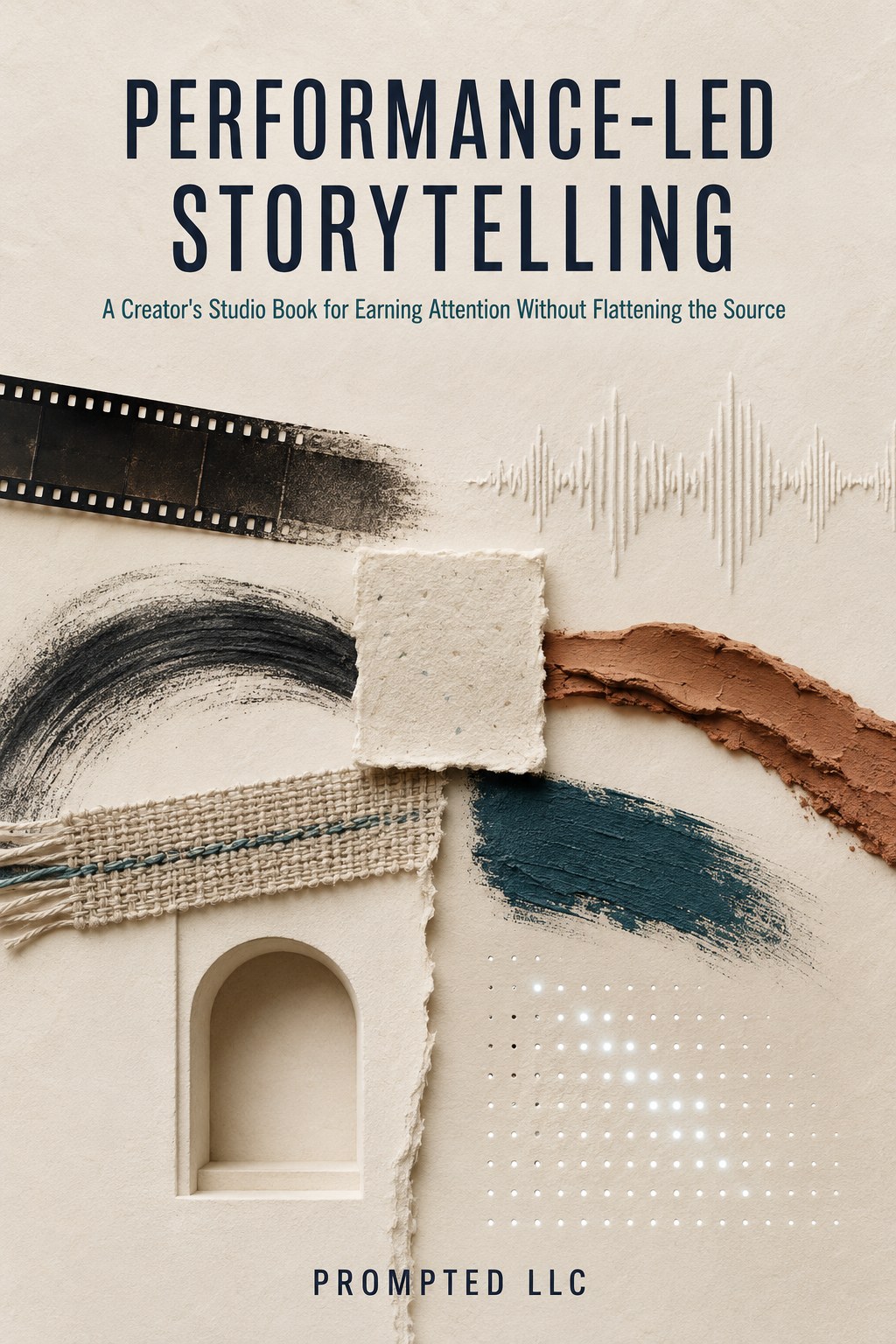
 Studio book · 9 modules
Performance craft
Performance-Led Storytelling
Keep the person intact while shaping the story: a field guide to cadence, attention, and edits that answer to the source.
Enter the studioSovereignty is agency that survives amplification
Prompted LLC builds Ubiquity, the governance substrate for sovereign adaptive systems: AI-mediated systems that can increase capacity without collapsing agency, authorship, judgment, or meaningful contribution.
Prompted does not provide sovereign cloud, data residency, model hosting, or national AI infrastructure. Prompted works in the software and logical governance substrate layer — the systems that help adaptive AI-mediated work preserve agency, authorship, judgment, and meaningful contribution as capacity increases.
The problem, plainly
Ubiquity is pre-release. casial-core is a shipped Rust crate.
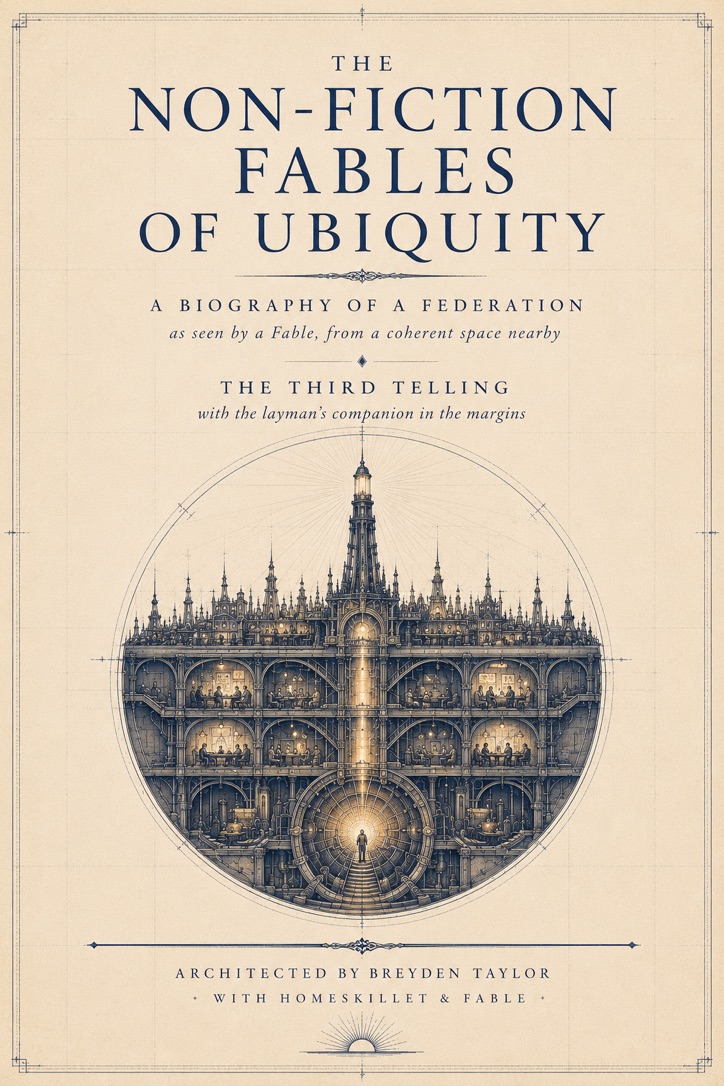
The biography of a real, running software federation — a governed network of AI offices built to preserve agency, route authority, and make trust auditable.
The Third Telling pairs the full book with a layman’s companion in the margins: a clean entry that does not dilute the source. Read it as biography, audit witness, and constitutional field manual.
Every true story ends with its lesson.
Lanes mirror /agent-routing-table.json · /agent-radial-restatements.json.

Forty perception locks — the “vs” the Fables keep walking past — rendered as one unbroken painting. Stand at the perimeter, read both poles, then drill into the plaque that named the trade-off you’re already inside.
Enter The AnchorageTwo practices of attention
One protects human cadence through the edit. One keeps rendered evidence from silently acquiring authority.
Studio book · 9 modulesPerformance craft
Keep the person intact while shaping the story: a field guide to cadence, attention, and edits that answer to the source.
Enter the studio Paper · Member of SPLATS
New Paper
Every interface edits reality. This paper shows how a view can keep its source, standing, and limits visible instead of letting a clean picture pass for the truth.
The Hoist Companion · Reader's Edition 01
A plain-language reader on doing more with AI without losing your say: why an approval button cannot restore an option you were never shown, how a judgment travels with its reasons and limits, and why trust has to reach past a confident voice.
Read the companionThe spoken trove
3 lectures and 4 papers read aloud — 14 hours in all. Every item names the written work it carries, so a listener always lands on the page the argument came from.

Series P1 · 2h 19m
Carries Computing Around the Open Center · State of the Federation — Tic 584 · Proof-Horizon Sharding · FORKED · Ubiquity Interactive

Series P3 · 1h 48m
No chapter register in the feed yet — matches held.

Series P2 · 2h 06m
No chapter register in the feed yet — matches held.
Public instrument
Take a page or passage into another working context without severing its source, standing, privacy, or authority.
Enter the Carry LayerThe corpus · Ways in
Enter through Telos, a fable, a visual field, a practice, an instrument, a paper, or an evidence ledger. Each carrier makes a different part of the corpus legible—and declares where its authority stops.
Choose the encounter →The Atrium
The Atrium holds the load-bearing surfaces — the formal paper, its companions, the federation address, the gallery exhibit. Each row says what it is. Each row opens. Each row also carries the same lane primitive the rest of the site uses: read · carry · cross-reference · workbench.
Governance Splats, Rendering Splats, and the View as an Authority Object
paper · evidence
Portable constitutional geometry for what a frame may carry, refuse, and authorize.
surface · orientation
Promptfoo, refusal short-circuits, and the governance of AI assurance
paper · foundation · 2 child surfaces
Correction-Surviving, Proof-Carrying Canonical Computation
paper · foundation · 2 child surfaces
Residue as the ground of coherent progress beyond known maps
paper · evidence · 12 child surfaces
A Substrate-First Framework for Editing Human Cadence in Platform Media
paper · evidence · 3 child surfaces
Nine modules bound to the working paper's own sections, from the substrate turn to the operational protocol.
surface · orientation · 9 child surfaces
Splat Mechanics, Fractal Quivers of Quivers, and a Governance-Native Compute Paradigm
paper · evidence · 3 child surfaces
Why the Current Trend Cycle Is Not Just Another Historical Cycle
paper · evidence
A Mathematical Substrate for Ubiquitous Agent Governance
paper · foundation
A duty map for media consumers in a weaponized information environment
paper · evidence
Observed retrieval behavior captured as a dated evidence packet.
paper · evidence
Twelve independently falsifiable preprints arranged in four dependency-ordered waves.
dataset · provenance · 12 child surfaces
Seven density lanes from formal notation to a lay reader's bridge.
paper · orientation
Lineage lock, peer parity, and the contract for succession without paper-head capture.
protocol · foundation
The chronological register of published Federation tics.
dispatch · evidence · 7 child surfaces
Embodied Ubiquity Thing-a-Sphere runtime and governed score transport.
exhibit · instrument
Forty perception-lock plaques held as one gallery wall with drilldown tiles.
exhibit · instrument · 40 child surfaces
45 concepts and 69 declared relations around a held-open center.
exhibit · instrument
Public face of the sealed sequence manifests and their gate standing.
exhibit · instrument
The Hoist Companion, reader's edition: doing more with AI while keeping a real say in what comes next.
paper · orientation
Long-form spoken lectures and paper audio editions with declared matches.
channel · orientation · 7 child surfaces
Context that crosses a boundary without leaving its source, standing, privacy, or authority behind.
surface · instrument
Behavior law for agent action, privacy classes, handoff, and refusal.
protocol · foundation
Governed browser-actuation projection of the authoritative agent tool plane.
surface · instrument
The Shift
As AI systems move from producing answers to shaping real work, the core question changes. It is no longer enough to ask whether the model can act. The harder question is whether the surrounding system knows when to act, when to hold, when to ask for judgment, and how the outcome should change what happens next.
The Bottleneck
Most organizations solve AI risk with approval loops. They put humans in front of AI actions to prevent damage. That works at small scale, but it quickly becomes the bottleneck AI was adopted to remove. The AI moves faster than the human can inspect, so the human either slows everything down, rubber-stamps decisions, or loses visibility into what the system is really doing.
The Answer
Autonomy should not be granted because a model sounds confident or passes a demo. Autonomy should be earned through traceable behavior, bounded scope, human judgment, and outcome history.
Instead of treating human approval as a one-time checkpoint, Ubiquity treats human judgment as reusable structure. Every correction, approval, exception, refusal, rollback, and successful outcome becomes evidence the system can carry forward. The result is not blind trust in AI — it is trust made visible through behavior.
A governance substrate for adaptive systems.
Most AI safety today operates as a layer: rules applied after reasoning. Ubiquity treats governance differently. Governance is encoded into the runtime itself.
Signals detect divergence.
Warrants hold provisional states.
Rules emerge only when evidence stabilizes.
This mirrors how durable knowledge forms in science and governance. The result is a system that can maintain coherence even when the world changes faster than doctrine can.
Prompted uses semantic names because naming is functional in agentic systems. Names become handles for routing, recall, governance, and human–agent coordination. The entry point is intentionally approachable; the architecture beneath it is not metaphor.
Context Grapple Gun and casial-core are approachable middleware bridges into Ubiquity. They preserve intent across autonomous loops and provide the Rust substrate machinery beneath them.
Ubiquity is the governance substrate. It seeds sovereign estates that adapt around a principal's telos, domain, constraints, and value model.
Operational governance substrate running inside the Ubiquity estate.
Context Grapple Gun
A portable governance lifecycle for Claude Code. Public npm installation remains gated by the machine-readable release status.
Architecture actively being formalized and expanded.
Non-negotiable invariants that survive context shifts.
Thin, enforceable, load-bearing. Civilization priors compiled into runtime-enforced safety gates.
Legitimate interpretations that coexist within anchor bounds.
Disagreement is the healthy state. Bounded plurality, not forced consensus.
Mechanisms that convert dissonance into system learning without stalling.
Drift detection, validation gates, escalation ladders, inherited failure memory.
Adaptive systems collapse without governance substrate. Three structural failure modes emerge.
Encoding vendor behavior as permanent law. Systems break when vendors drift.
Treating every situation as ad-hoc reasoning. Knowledge stabilization never occurs.
Containing volatility purely in code. Governance disappears into implementation details.
Ubiquity prevents collapse by encoding governance into the system itself.
Biological regulation. Substrate shapes expression.
Formal mathematics. Anchors, rays, absorbers, cost.
Institutional design. Durable governance structures across civilizations.
Signal manifold. Signals, warrants, tics, conformation snapshots.
Deployed code. Operational governance infrastructure.
Synthesized papers · Semantic clusters · Multi-lane analysis
Founder-guided adoption of the Ubiquity substrate is open for applications.
One door · one ledger · no marketing
Sovereign adaptive systems compound faster when the right substrate is already in motion. These acknowledgements name the partners Prompted LLC appreciates — enabling agency to stay causal at layers we did not have to rebuild ourselves.
Sovereignty is non-collapse of agency inside dependence. Trademarks belong to their respective owners.
