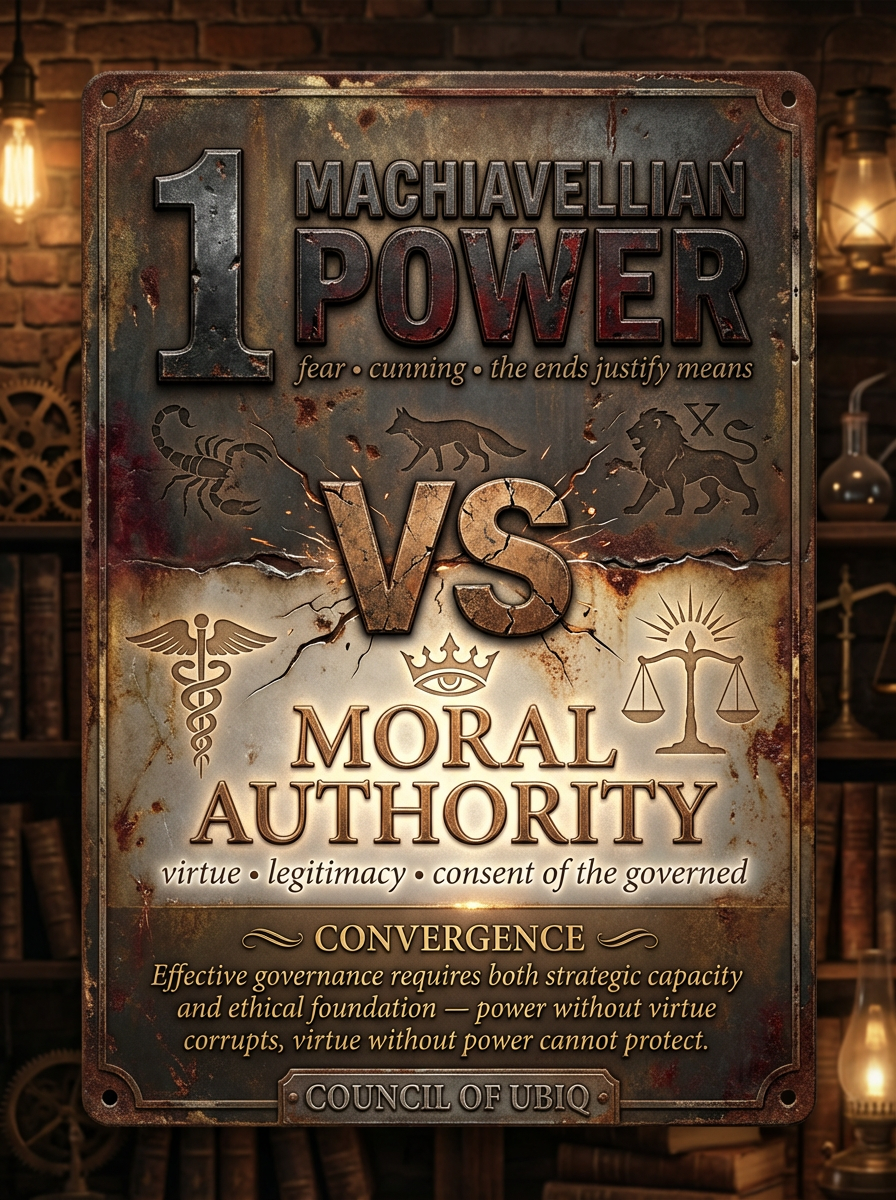
Machiavellian Power vs Moral Authority
Core Truth
Power without virtue corrupts both ruler and ruled, revealing the essential need for ethical governance. Environmental Constraints: Rated on a scale from 0-10, with Threat (9), Scarcity (8), Time (9), and Info_Asymmetry (7), indicating significant challenges leaders face.
Perception Lock
Balances the dichotomy of strength versus virtue, ensuring moral reasoning prevails.
Conformity Trap
Single strongman narrative, fear-based compliance
Coordination Trigger
Multiple leaders modeling moral authority under pressure Core Truth: Power without virtue corrupts both ruler and ruled Cultural Artifacts: Machiavelli's "The Prince" (Italian Renaissance, emphasizing pragmatic power); Confucian "Mandate of Heaven" (Ancient China, where rulers lose authority without virtue); King Ashoka's edicts (Ancient India, Mauryan Empire, shift from conquest to moral governance via Buddhist principles); Zulu proverbs like "Umuntu ngumuntu ngabantu" (South Africa, people are people through others, emphasizing communal virtue over individual power).
Cultural Artifacts
Key influences include Machiavelli's "The Prince", the Confucian "Mandate of Heaven", King Ashoka's edicts, and Zulu proverbs, each highlighting different aspects of power and virtue.
Primary Sources
Federalist-style- 01
“It is necessary for a prince wishing to hold his own to know how to do wrong, and to make use of it or not according to necessity.”
- 02
“He who exercises government by means of his virtue may be compared to the north polar star, which keeps its place and all the stars turn towards it.”
- 03
- 04
Environmental Constraints
Signal Examples
War declarations, coup attempts, emergency powers, "national security" invocations U-Coin Value Derivatives: Minted for verified moral leadership under pressure (trust coefficient × virtue demonstration), burned for power-grabbing during crises; consciousness levels required for emergency authority
U-Coin Value Derivatives
Minted for verified moral leadership and burned for power-grabbing, reflecting the relationship between trust and virtue.
Ubiquity OS Solution
Perception-locks prevent "emergency" from collapsing moral reasoning into pure power; swarm synergy coordination maintains virtue even under threat; emotional engine balances cortisol (stress) with oxytocin (trust)